
Values on a Decatur Property Record
A Decatur County property value is not one number. The Appraiser estimates fair-market value using sales comparison, cost, and income approaches. Assessed value then follows Kansas classification rules. A price recorded on a deed is a transaction fact, not a current opinion of market or assessed value.
| Value | What It Is | Where |
|---|---|---|
| Assessed value | Appraised value multiplied by the classification percentage | Appraiser assessment record |
| Market or appraised value | The county's estimate for assessment work | Appraiser record or notice |
| Last sale price | Consideration from a past transfer when recorded or maintained | Deed or last-sale field |
| Land and improvement | Separate components that may make up total appraised value | Ask for the parcel record |
Residential real property in Kansas is assessed at 11.5 percent. That ratio is only one of several. Vacant lots sit at 12 percent. Commercial and industrial real property generally carries 25 percent, and other classes differ. Agricultural land plus state-assessed utility and railroad property follow separate treatment. So know the classification before reading any assessed value in Decatur County property records.
Looking Up a Decatur Property Value
The Decatur County Appraiser publishes no county-hosted parcel search form. Request an existing parcel record by full address or legal description instead. Ask which value fields the office maintains and can release.
- Give the Appraiser the address, city or township, and known parcel number.
- Ask for the valuation year, classification, ratio, land, improvement, total appraised, and assessed values.
- Request last-sale date and price only if maintained and public.
- Preserve the source and retrieval date before comparing values.
- Assessed value
- Appraised value after the statutory class percentage is applied.
- Market value
- The estimated fair-market value used in valuation work.
- Assessment ratio
- The percentage assigned to the property class.
- Consideration
- A deed transaction amount, which may not equal market value.
How Decatur Values Are Developed
The Appraiser analyzes sale prices, construction costs, and rents. Sales comparison draws on market evidence from similar property. The cost approach weighs replacement or reproduction cost less depreciation, and the income approach applies where a property's earning capacity matters. These are mass-appraisal tools. Applied across many parcels, they do not promise the price of any single future sale. Physical traits, land class, use, and available market evidence all shape the result.
Separate Value From Sale Price
A deed can document a price or consideration. That number is not always a clean market benchmark. Special relationships, bundled tracts, non-cash terms, or estate transfers can skew it. Confirm the amount covers the same parcel. Also confirm the sale was open-market. The Appraiser may use sales as evidence. That does not set every parcel to its last recorded price. For deed facts, contact the Register of Deeds and match the legal description.
Comparison rule. Compare the same valuation year, property class, and type of number. An old sale price and current assessed value measure different things.
Read Decatur Classification Ratios
The Kansas property-tax calendar provides state timing context for Decatur property values.
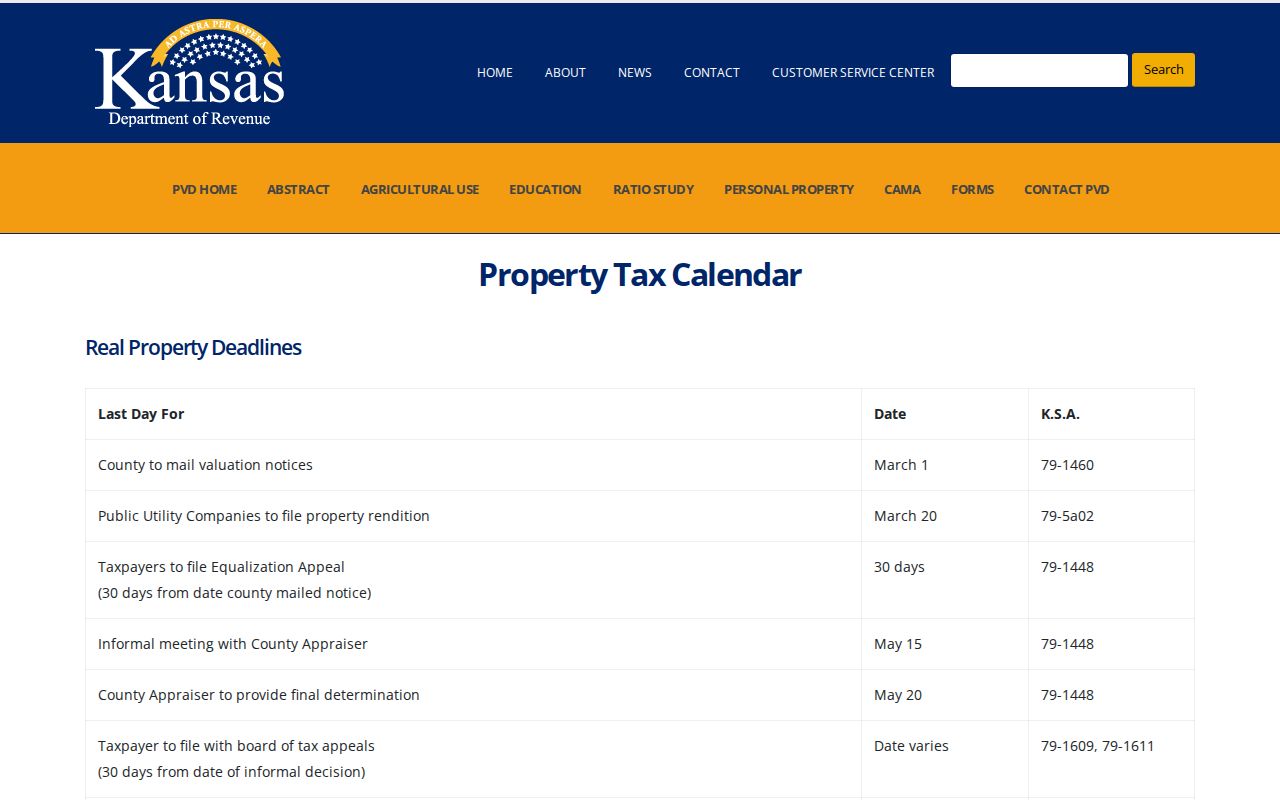
The state property-tax calendar explains milestones, but the parcel notice remains the source for its own value and deadline. Ratios do the math before tax rates apply. A $100,000 residential appraised value at the 11.5 percent ratio yields an $11,500 assessed value. Commercial and industrial property generally uses 25 percent. So do improvements on agricultural land. Public-utility real property uses 33 percent. All other urban and rural real property is listed at 30 percent. That arithmetic explains ratios only; it is not a valuation or tax quote for any Decatur parcel.
Preserve the Decatur Value Year
Log the county, parcel number, and valuation year. Add the address or legal description, the class, the appraised and assessed values, the land-and-improvement split, any exemption flag, and the source. The year matters most. Without it, two accurate figures look like a conflict. Valuation notices generally go out by March 1. Year-specific dates should still be checked; the state property-tax calendar marks assessment milestones, and tax bills or appeals belong on the property-tax records route.
Note: Decatur County offers no public parcel card online, and no published schedule says how often its records refresh.
Compare Similar Decatur Parcels
Compare like with like. Type and year must match. Keep location, use, size, and condition aligned too, or the comparison falls apart. An Oberlin lot is not a farm tract. Preserve field names and dates, note whether each figure is land, improvements, or a total, and account for class ratios, since similar assessed values alone make a commercial parcel and rural acreage interchangeable nowhere.
Understand Exemption Flags
The Appraiser tracks parcels eligible for exemptions or tax relief. Exemptions change taxable treatment. They do not erase market value or predict a sale discount. Ask what the flag means for the stated year. Ask whether it shifts appraised, assessed, or taxable value. Never infer personal facts about an owner from a code.
Check Decatur Value Components
Land and improvement values move differently. A building addition, demolition, or condition update can shift one component while the other holds steady. So can land reclassification or revised market evidence. Ask for the characteristic record behind any odd change. Year-built, use, acreage, dimensions, and building traits are potential request fields, though the county publishes no online parcel card confirming them all. Confirm what the office maintains. An error in a characteristic can affect valuation without saying anything about title quality.
Keep Taxes Separate From Value
Assessed value is just one input. The county clerk computes levies and certifies rolls, while the Treasurer collects taxes. A final bill can include rates, installments, special assessments, interest, or fees, none of which are themselves a property value. The Kansas online payment service requires a county statement and exists to take payments. It is not a free Decatur value search. Use the Appraiser for meaning, the Treasurer for payment.
Follow the Kansas Value Calendar
Kansas counties mail valuation notices by March 1. Owners then have about 30 days to open an appeal. Check the current notice for the exact deadline that applies to your Decatur County parcel.
The flow after that is orderly. The County Appraiser certifies values first. The Clerk then folds those valuations into levy calculations. The Clerk also certifies the tax roll to the Treasurer. A valuation, a levy, and a final tax bill are three linked but separate steps. When reviewing any figure, note the record year. Note the parcel number, class, appraised value, assessed value, and ratio too.
Check Decatur Value Components
Land and buildings move for different reasons. In Decatur County, new construction, demolition, condition changes, a reclassification, or fresh market evidence can shift one component. The other may hold steady at the same time. Ask the appraiser which traits support each figure.
Year built, use, acreage, dimensions, and building details may appear on a property card. However, the county does not publish a live card showing every field. Confirm with the office which characteristics are actually maintained for your parcel.
Request a Complete Value Inventory
A strong records request covers the whole value picture. Ask for land value, improvement value, total appraised value, assessed value, class, assessment percentage, any exemption flag, valuation year, and the value history if the county maintains it as a public record. Always include the parcel number and legal description. That keeps every figure tied to one tract.
Ask whether last-sale data appears too, and how the county labels it. A prior sale can illuminate the market evidence behind a value, but it never replaces the current appraised value. Leave blank or unavailable fields blank. Do not estimate them from a tax bill or a commercial listing, since those sources serve different purposes than official property records.
What a Decatur Assessor Value Is Not
An assessor value is not a sale guarantee. It is also not a private appraisal, a repair estimate, or a title conclusion. Expect the county figure to differ from an asking price, a lender appraisal, an insurance figure, and the eventual closing price. Exemptions and tax rates shape the tax bill without changing what a buyer pays.
Use the county value only for its stated purpose and year. For a transaction, financing decision, or litigation, get professional valuation advice. The Decatur property-tax records page explains bills and how to challenge an assessment.
Value vs price. A Decatur assessed value supports taxation and is not a prediction of sale price. Use a licensed appraisal when the decision requires one.