
What the Decatur Current Owner Record Shows
The Decatur County Appraiser maintains ownership changes, parcel boundaries, and property characteristics. The county offers no online parcel-card lookup. Ask for the parcel record by full address or legal description instead. Staff can tell you which owner and sale fields they maintain and release. Request only what the office actually keeps.
| Owner of Record | Assessment owner name, if maintained and releasable |
|---|---|
| Mailing Address | Destination for owner tax mail |
| Situs Address | Physical property location |
| Parcel Number | Account key used to reconcile records |
| Deed Reference | Ask whether a recent instrument is cross-referenced |
| Last Sale | Ask whether date and price are maintained |
An owner of record is whoever the tax roll names for the parcel. That could be one person, several co-owners, a trust, an estate, or a company. It is not the occupant. Mailing addresses often differ from the situs. Tax bills may go to a trustee, manager, or out-of-town office.
Request the Current Decatur Parcel
The county Appraiser page confirms the office duties behind a current-owner request.
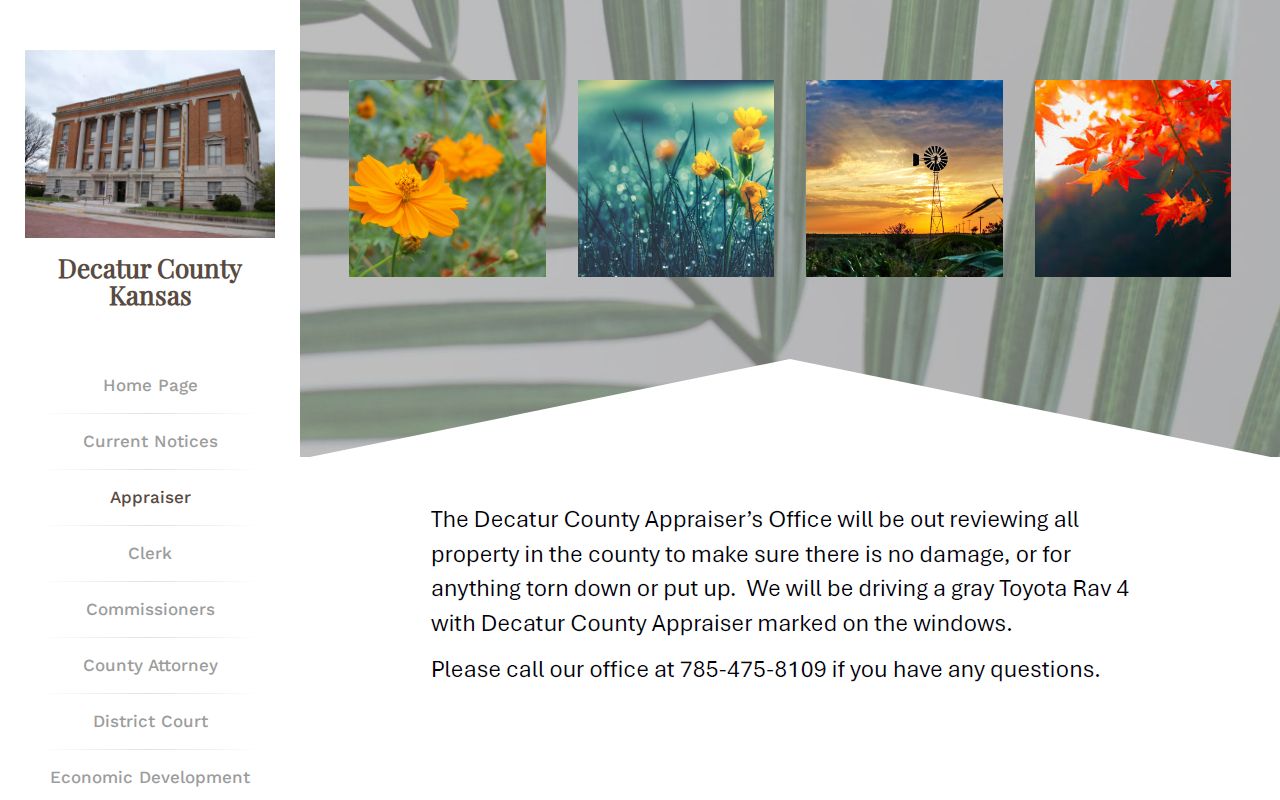
Owner fields require confirmation with the office. The Decatur County Appraiser sits at 120 E Hall Street in Oberlin, KS 67749. Call 785-475-8109 or email decaturappraiser@dccoks.org. Hours are weekdays, 8:00 a.m. to noon and 1:00 to 5:00 p.m.
Provide the complete address, the city or township, and any legal description you know. Request the parcel number and the current owner field. Ask for mailing and situs addresses, classification, values, characteristics, and exemptions. Request the latest sale data if those exist, and ask when the owner field was last updated.
Note: Record the roll year and the date you retrieved the information. The county publishes no refresh schedule.
How Current Is Decatur Ownership
A sale closing, a deed recording, and a tax roll update are three separate events. The roll can still list the seller weeks after a new deed is recorded. Decatur County publishes no fixed lag figure. So never promise a number of days.
Compare the assessment name against the newest instrument touching the same legal description. State law feeds recorded-deed address data into tax administration. But it does not change every field at once. Your current-owner conclusion is strongest when the parcel number, legal description, grantee, and dates all agree.
Recent-sale caution. The roll can lag a transfer. The newest recorded deed may be the more current ownership evidence, though neither lookup is a title opinion.
Confirming the Current Decatur Owner
The Register of Deeds records conveyances from its first-floor courthouse office. Its official page lists contact details only. The county publishes no online grantor-grantee index, coverage dates, or image fees. A direct request is the reliable route to deed records.
- Obtain the assessment owner, parcel number, and legal description from the Appraiser.
- Contact the Register of Deeds with that name and description.
- Ask for the newest conveyance, recording date, grantee, document type, and instrument or book/page reference.
- Record any conflict and ask each office when its result was last updated.
- Owner of record
- The party named in the official record consulted.
- Assessment roll
- The parcel and value record used for tax administration.
- Situs
- The property's physical location, distinct from owner mail.
- Recording lag
- Time between a conveyance and its appearance in another county system.
Read the Latest Decatur Deed
A deed names the grantor, who conveys the interest, and the grantee, who receives it. Match it by legal description, never by name alone. Ask for the recording date, instrument number or book and page, document type, parties, and return address. Decatur publishes no list of searchable online fields.
Reach the recorder at 785-475-8105 or decaturdeeds@dccoks.org. Office hours run weekdays, 8:00 a.m. to 5:00 p.m. Ask about copy and certification prices before ordering, since the county posts no fee schedule.
Identify a Kansas Entity Owner
An LLC owner can be checked through the Kansas Secretary of State using its exact name. That search supports business-name, business-ID, and resident-agent routes. A resident agent accepts legal service. That role does not make the agent the landowner, and it may not reveal everyone behind the company.
Trusts and estates can call for different records. Read the deed for a trustee or fiduciary name, then check public probate information when an estate transfer explains the vesting. Restricted court records remain restricted.
Separate Owner From Occupant
A current-owner record names who the government says owns the land. It says nothing about who lives or works there. A leased farm, a rental home, a vacant tract, and a business parcel can each split owner, occupant, situs, and mailing facts four ways. Keep those labels straight in your notes.
When you contact someone lawfully about the land, use the mailing address exactly as released. Cite the parcel number. Never guess a private home address from unrelated people-search data.
Preserve Current Owner Evidence
A solid current-owner note should carry the parcel number, legal description, and assessment owner label. Add the mailing and situs addresses, roll year, retrieval date, and latest deed reference. If a field is missing, mark it unavailable. Do not fill gaps from a third-party profile.
Save the exact spelling of any entity or trust. Note whether the deed and roll agree. That discipline keeps an old result from masquerading as current.
Correct a Decatur Owner Mismatch
A mismatch can follow a recent recording or a clerical slip. It can also stem from an estate transition or a parcel split. Take the same legal description to the Appraiser about the assessment field. Take it to the recorder about the deed. Ask for an explanation, not a ruling. Genuine title disputes, heir questions, or competing claims may need a professional or the courts.
Check the Current Legal Description
A current owner has to match current land. An older deed may describe a parent tract that was later split, combined, or platted. Set the tax roll description beside the deed. Where acreage or lot references differ, ask the office about related parcel numbers. The parcel identifier and legal description give the stronger cross-reference. A familiar street address is not. Minor abbreviations are common. A changed section, lot, block, or exception deserves review before you force a match.
Use the Current Mailing Field
The tax-mailing address is a contact field, nothing more. It can route notices to a post office box, a manager, a trustee, or a corporate office. Keep the owner label and the mailing label together. An unlabeled mailing address gets mistaken for the situs. The County Clerk prepares and certifies tax rolls to the Treasurer, which helps identify the tax year, while the Appraiser tracks ownership changes. The Treasurer collects the tax bill but does not replace the recorder as the conveyance source. When a field looks stale after a deed, ask when it was last updated. Decatur publishes no exact processing interval. Report the timing gap instead of guessing.
Confirm the Custodian Response
Preserve whatever the Appraiser or recorder sends back. Note the date and delivery method. Record the fee estimate too. Also note any statement that a field is not maintained. Ask for existing records only. When another office holds the requested item, follow the referral and keep both responses. That small audit turns an assumption into a verified current-owner finding. It replaces a guess built on a missing online form.
Reaching a Decatur Property Owner
A mailing address on an existing parcel record is the cleanest public contact clue. The county may release it. Write about the parcel, state a neutral purpose, and let the recipient decline. Decatur sometimes withholds or redacts a field. Ask for the statutory basis rather than working around the protection. For title, boundary, or estate disputes, rely on the custodian records and suitable professional advice. A current owner search cannot settle every lien, easement, heirship claim, or unrecorded interest.
Lawful use. Public owner data supports property research and due diligence. Never use it to stalk, harass, intimidate, or harm a person.